I agree, the price at Amazon.com is $673 (and you still need RAM and a SSD). You can build a pretty decent gaming PC at that price, the only disadvantage being portability. But how often do you need to move your gaming PC?
The Iris Pro 580 has about the performance of a desktop GTX 750ti which isn't bad, it can actually match the performance of "discrete" low to mid range mobile GPU's from both companies like the oh so popular GTX 750/850M.
You won't get any decent GPU in a package this small anyhow, that said you can plug in an external GPU via the Thunderbolt port with ease.
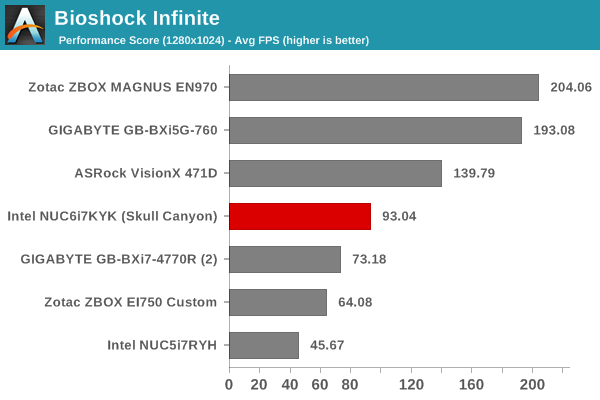
The 580 manages to beat the GB-BXi5G-760 in some benchmarks which has desktop GTX 760 in it, it only really gets smoked by the Zotac box which has a desktop GTX 960 which is a 200-230$ card.
The only downside is that these boxes are nearly the same price as desktops with similar specs. So I may stick with desktops just because they are more easily upgradable.
There are no conflicting benchmarks, synthetic benchmarks are never a good indicator of actual gameplay performance, and passmark is the one of worst benchmarks to begin with.
That said I really like this new NUC, it can actually replace a laptop for most people that only drag it to work and never really work on the go outside of an office environment.
It's considerably cheaper and blows the MBP15 out of the water when it comes to performance, heck if you want to do high end gaming on it than an external GPU enclosure + a GTX 1080/1070 + the NUC would be cheaper than a high end gaming laptop while delivering much more performance.
Even if you need a more mobile setup it wouldn't surprise me to se 3rd parties making battery packs for the NUC and you can get a portable LCD monitor like the AOC E1659FWU for about 100$, and considering that most places people would work with a laptop (coffee shops, restaurants, libraries, trains, airplanes etc) anyhow have power you might not even need a battery pack.
> There are no conflicting benchmarks, synthetic benchmarks are never a good indicator of actual gameplay performance, and passmark is the one of worst benchmarks to begin with.
I have found passmark to be excellence in predicting real-world performance for both GPUs and CPUs.
I believe that it is because the game FPS benchmarks are testing things other than just pure GPU performance -- which is okay if you care about those specific games, but it then isn't an indicator of GPU performance. In many games the GeForce 760 doubles the Iris 580 performance as it does in the PassMark ratings:
Benchmark points are meaningless you can have a card which scored 3000 and a card which scores 1500 but both of them won't give you playable framerates in games.
If you are looking for game performances don't bother looking at synthetic benchmarks.
Same goes for compute performance look at real world benchmarks the rest is meaningless.
You should also consider that benchmarks are the most optimized software for all vendors which adds another layer of illusion on top.
Keep in mind this is probably more drivers than hardware. NVIDIA and AMD (by way of ATI) have many more years of experience optimizing drivers for games. I wouldn't be shocked if a year from now these chips were pretty even with some lower end gpus entirely. I think the real issue is that you don't upgrade CPUs like you do a GPU, especially for Intel, since it almost always means a new motherboard and ram. I just wish a 8 core Intel didn't cost a small fortune, hopefully AMD's new chips put enough pressure to make that happen.
They missed an opportunity to add GDDR5 directly on the mainboard. That's how AMD is cranking out pretty good performance for the PS4 despite it using an APU.
The Intel CPU used in this product has a 128MB L4 cache to be used by the CPU and GPU. It has it's own benefits compared to the PS4's GDDR5 unified memory approach.
Yes. Thunderbolt 3 supports 40Gbps and should allow for an external GTX 1070 or 1080. The cheapest Thunderbolt 2 PCIe chassis on Amazon is around $200, and I don't see why we can't have a Thunderbolt 3 PCIe chassis at this price point.