>We are at the stage, that merely acknowledging someone's sex or race will earn you these labels.
That in itself is too broad a generalization though, because there are many times when mentioning someone's race/sex is, due to context, subtly racist/sexist.
Generally, if you mention someones race or sex and that information is not actually relevant in any way to what you're saying, you are helping to perpetuate stereotypes and prejudice. It doesn't matter that doing so feels normal to you; shouting slurs at minorities feels normal to neo-Nazi[1] skinheads too. The hard part about prejudice is that it isn't simply solved by honest people acting naturally. It's solved by honest people trying really hard not to be prejudiced, because prejudice is innate.
[1] ed: thanks for pointing this out, peterwwillis
Please, please, please, read that page. Not only to save yourself and others the ignorance of believing skinheads are racists, but also because there's a culture and a people that will be forever denigrated because the media and parroting readers will continue to perpetuate this stereotype.
My apologies. I should have specified "neo-Nazi skinheads". This is not in the same category as racial or gender prejudice, however. It is simply a matter of mislabeling.
No apology necessary. It's just incredibly frustrating that the label has been taken to such an extreme to the point that a whole subculture is guilty by association.
It's definitely not the same thing as racial or gender prejudice, but it can be just as damaging to the people who live under the label and deal with its unintended consequences (like getting beaten outside a club for shaving your head and wearing doc martens). We Hackers are lucky that we live in a world where geeks are now the popular cool kids and we can take back a word that used to get us expelled.
Except in this case you are talking about a subculture which is preoccupied with gratuitous violence (even outside the context of racism). That makes it not very comparable to race, gender or geeks.
Beating people is obviously not nice. But if you get beaten outside a club for intentionally dressing the same way as a subculture which is historically well-known for beating up people outside clubs for fun (or being a foreigner, or being gay, or being a hippie, or being Republican...) then that might be unfair, but it isn't at all surprising. And it doesn't even hold a candle to being attacked for things over which you have no control, like being a foreigner. It's not even related.
The comparison of this to racism and sexism is a ridiculous excess of political correctness on behalf of people who don't need it. Just stop. Nobody has an obligation to preserve the delicate feelings of skinheads from the consequences of the skinhead cultural obsession with violence.
I find it hard to agree with your point. Not because of your suggestion that there's a cultural obsession with violence, but because you seem to think it's fine that these people get stereotyped, because their supposed violent culture deserves it, or something. Wrong is wrong, and stereotype is wrong.
On your comment about a 'cultural obsession with violence': Perhaps that's your personal experience. It's not been mine. I have met many kinds of skinheads, from extremists and gangs to kids who just liked to hang out listening to reggae. I'm pretty sure you'll find lots of different cultures that have widely ranging attitudes.
I can tell you that skinheads are probably more likely than most people to jump in and defend someone, sometimes with violence. But they're also some of the nicest people i've known. I tend to find all kinds of working-class people act this way, regardless of subculture.
I can also tell you that at most punk or hardcore shows i've been to, if there's one or two kids standing in the middle of the pit randomly attacking people, it's usually some form of a skinhead. It's an embarrassment that most people in the subculture don't agree with at all. It is however a great opportunity to meet violence with violence, and show the individual that their actions are not welcome.
Interesting. The GP's usage is aligned with every instance I've encountered over the past 20-odd years (in the U.S.), while the Wikipedia entry appears to have a European focus and is starkly different from my understanding of U.S.-ian denotation and connotation of the term.
See, e.g., Merriam-Webster:
"2: a usually white male belonging to any of various sometimes violent youth gangs whose members have close-shaven hair and often espouse white-supremacist beliefs."
Go to a concert or local show which has music that skinheads like. Find one, and talk to them. They're pretty nice people generally, though they also may be defensive from getting so much shit for being associated with the white power fuckheads. I've heard the european skinheads are a lot more touchy than the american ones.
If they have a patch that says SHARP on it, they are 100% anti-racist, and will probably beat you up if you make a racist joke. A bit violent, yes. But not without reason. Again, not unlike some others (people like Ian MacKaye used to shave their heads and get into fights over stupid personal beliefs and weren't skinheads at all...)
Off topic, but I find it puzzling that there's basically a handbook for a subculture trying to be different. It seems like a logical impossibility for a subculture to actually be unique and different, when there's essentially a dress code (short hair, levis, dr martens). I'm not trying to make any value judgements on the subculture, just trying to understand.
Maybe the point is that the subculture / group itself is unique, and I'm mistaking that for individual uniqueness / individuality?
When I was young, I was a very shy kid with a stutter. Needless to say, school wasn't always the most pleasant place. By the time I hit high school, I was straight up angry. I was so sick of being beat up and called 'fag' that I resolved to be different.
So, I became a punk and started going to as many punk shows as possible.
All of a sudden, I certainly was not one of the cool kids, but I was part of a group that was disgusted by the cool kids. Thing is, our group had its own handbook. My friends were hardcore straight edge punks - we eschewed drugs and alcohol. We took much of our fashion sense from goth and grunge (really big pants, big boots, and lots of black). And, our particular group believed that we needed to be taken seriously, so we avoided mohawks and really bizarre piercings. We even had our own rituals - by Friday, we were so sick of everything that we needed to find a punk show so we could get into a pit and take some aggression out.
At the time, I thought I was a free thinker who became friends with a group of other free thinkers. But, to become that non-conformist, I had to conform to certain norms. In my example, your statement is correct - the subculture itself was unique, but we had very strict rules, a strict uniform, and rituals.
I understand, and this helps me resolve a contradiction of understanding I've had for a while. I always thought of the sardonic saying "I want to be different, just like everyone else." I get it though - the idea is to still identify with a group, just not the mainstream (default?) group. But the group still has common values by which it can be identified.
As another commenter pointed out - I also hadn't realized that unique can also mean "not typical." I've always interpreted it as one of a kind, and it makes a lot more sense recognizing this definition.
I haven't fully formed this thought (I apologize), but you made a great comment and I wanted to reply! (Thanks by the way, for your comment)
I'm going to go out on a limb and argue that, in high school, my group of non-conformists likely conformed more than the group of conformists we ranted against so much. Examples may help:
- I got into Joy Division in Grade 9. Suddenly, all my friends listened to Joy Division (and we even gave up on mohawks because Ian Curtis inspired us so much).
- Or, the beginning of grade 9, we were all obsessed with Advanced Dungeons and Dragons. But then, my friend Drew bought Shadowrun books. All of a sudden, we were all obsessed with Shadowrun (and cyberpunk in general). We were so obsessed that AD&D immediately went from the ranks of 'amazing system' to 'a stupid game for kids'.
- Bad Religion was playing in Edmonton. Suddenly, Bad Religion was our collective favourite band and we planned a crazy road trip to go see them play.
I don't totally understand the mechanism at play, but your comment brought all of this to mind. I suspect that since we were so socially outcast (because we all tried so hard not to conform), we felt that we couldn't lose what friends we had. Consequently, nobody rocked the boat about anything until University.
Oddly, we all drifted apart while we were in University. In retrospect, it looks like we only stayed together because we conformed so perfectly...
Thanks again for your comment - I love that I had these thoughts and I owe you for them!
Skinhead culture is about embracing things you do like, not rejecting the things you don't. They're not trying to be different. They just like the music and the clothes and the attitude, as well as the extended family nature of the people who identify as they do. I'm pretty sure everyone who associates themselves with any label is doing the same thing.
I wanted to thank you for your comments in defense of skinheads yesterday, but time got away from me (and I have a touch of ADHD). Thanks for jumping up in defense of a group I have a whole lot of respect for!
The way I always take it when I hear someone say they're their own person and they reject society is that they're merely choosing another culture to fit into. Counter-culture is not the lack of a culture, but rather the rejection of mainstream culture and instead choosing to fit in with a different group.
Emo/scene, goth, skinhead, hipster, whatever group they're a part of, it's true that they are being an individual and being counter-culture if you take the language liberally to mean they're simply making a choice to associate with another culture. Even if it's just a phase or a fad, but those people are not similar to the rest of society. Every society has a dress code; by not being a part of the majority, they are in fact "unique" in the meaning of "not typical; unusual". Language is fun!
Some subcultures are non-conformist, and are very positive toward other subcultures. This is not one of those. The dress code is something skinheads judge each other on. It also advertises to others that you are a tough, aggressive person and that you are aligned with whites, or the working class, or whatever.
If you just went around in flip-flops and cargo shorts there is no way anybody would know that you identify as a skinhead, or know they should fear you.
I would argue there's some work that needs to be done on the other side of the coin, too. There are too many people making money off feeling oppressed. I personally don't feel the answer is making honest people go out of their way to carefully word their sentences to avoid mentioning a characteristic of a person, I feel the answer is understanding that saying "that is a person" is nowhere near as descriptive as "a black man from Chicago".
And herein lies the difficulty with reconciling language (which is a way to communicate descriptive experiences) with political correctness. Is his race relevant? Is his gender relevant? Is his city relevant? Maybe, maybe not. But the point is to describe the scene as it exists. The mere mention of descriptive words are often taken as prejudice when that's not the intention. Let's flip that back around. When I say "that person from Chicago", who do you picture in your mind? If you picture a man/woman, black/white/latino/asian, tall/short/fat/etc, you're being "prejudiced". Because I never mentioned any description of the person. But without that information, your mental picture of the scene is incomplete and your brain is going to fill in those blanks. Language has words you can add or omit to imply discrimination. "That black man from Chicago." "Another Asian from Chicago". "Of course, he's white." In absence of these deliberate hints, it's asinine to assume anyone is taking any sort of position.
When I go camping I don't say "I stayed somewhere with plants", I say "I slept in my tent on the ground in the Yosemite forest." That's not prejudiced against trees just because I called it a forest, nor against the Earth because I mentioned the ground. The more prevalent problem is not people being prejudiced, it's people feeling prejudged just because they expect to be prejudged. Why should someone go out of their way to reword and complicate their story when you're (hypothetical "you") are going out of your way to unword and read more into their story than they actually said?
(This isn't in response to the linked story, merely to mistercow's point)
There most certainly are people who have become celebrities off fostering the notion that true and abhorrent racism is everywhere. They make the news, they travel to picket, they write for newspapers, and in one case have actually been the subject of a South Park episode about creating racism out of nothing.
Likewise, there are religious figures who are making money off going on TV and shouting about how their religious freedoms are being trampled on and how it literally is an "us vs them" fight and if they lose it's game over for their deity.
Likewise, there are celebrities who get their paycheck in part or full from finding sexism in daily life. Ryan Singel just became one of them.
It's the power these people, few though they may be, hold over the discussions in society, the power to push political correctness and make people second-guess their words and actions to the point where it's impossible to keep up with what is polite to say and what will get you fired, beaten up, or cast out. There's money to be made in controversy, and that money isn't going uncollected.
True and abhorrent racism isn't everywhere, but it is endemic in most societies. And the vast majority of people who have reached 'celebrity' status for their writing on the subject have written because they felt a pressing need to do so, not in order to profit from controversy. If money is your bag, there are far easier ways of making it than trying to become a successful author.
I don't want to name names because for many of the people, breeding controversy is not their only goal. However, the Westboro Baptist Church and various notable Fox News celebrities (the ones who frequent the monologue of The Daily Show) are two cases where there is nothing going on except for profiting from false controversy.
Like I said, they are few. But they do exist, and they do irreparable harm to the discourse of political correctness by feeding off the fear that a group of people has of discrimination.
Untrue. I can't find the exact story I was thinking of, of a man in a wheelchair suing every business in his town that doesn't strictly adhere to ADA standards, but apparently it's not even as rare as I imagined.
And yes, you can say that these places should be handicap accessible, but there is no denying that some of these people are definitely making a profit from these lawsuits.
That's not making money off of feeling oppressed. That's making money off of successful serial lawsuits. Whether or not they feel oppressed doesn't enter in to the business model.
In the case of Hirsch, it's really hard to tell anything since an NY Post article (not a reputable source) appears to be the only primary source on the subject.
As for the ROHO post, the claim that they are raking in "huge amounts" of cash is pretty dubious. Even Hirsch with his 87 lawsuits would have brought in under $4500 total for his efforts. Not an insignificant amount of cash, but hardly a gold mine.
I would argue that it is making money off the feeling of discrimination. The serial lawsuits are just a tool being used to make this money. Just as Ryan's soapbox as editor of Wired is a tool, the media is a tool for getting out the message of the "War on Christmas", etc. You don't actually have to feel oppressed to use the fear of oppression as a tactic in getting what you want. In Wired's case, there was no sexism either implicit or explicit. But you know, calling sexism gets pageviews and attention. And those things lead to money.
Has Hirsch really been tortuously injured by the lack of handicap-accessible businesses? It doesn't matter. What matters is that he is using the fear of discrimination to justify a lawsuit (or 87). This is definitely going beyond my original point of the use of language. The original point was that I cannot give offense to you, offense is something that can only be taken. Therefore it is up to the audience to be damn sure offense was implied before it is taken.
Yes the complaints are more common than the occurrence (I think that's pretty normal, though), but the occurrence isn't uncommon. Back in my reddit days I was accused of anti-semitism merely for saying that creating Israel at that particular location was a mistake. Was that a real person? A false flag troll? Who knows.
I've also read accounts by Jewish people whose family members called them "self-hating Jews" because they criticized Israel.
But these anecdotes are not that meaningful. They do tell us the views of some extremists, but they tell us nothing about the prevalence of that extremism.
Reddit's users have always struck me as fantastically antisemitic. I think a lot of them do it for shock laughs, but the genuine article is present as well.
Saying Israel shouldn't have been born in that location isn't the same thing as saying Israel shouldn't exist, but Israel is the only country whose mere existence seems to require justification. Framing Israel's political problems as if they can be easily solved by not having an Israel certainly looks analogous to solving a Jewish problem by not having Jews. I'm absolutely not saying this is what you're saying, but this is how conversations about what should have happened instead are perceived by us Jews.
>Israel is the only country whose mere existence seems to require justification
Well, that's because most other countries weren't plopped down in the middle of an inhabited region, resulting in decades of violence and oppression that, and this part is critical, continue to this day. The US also shouldn't have been plopped down on the land inhabited by American Indians, but since the dust from that has mostly settled, it serves as a less poignant example of the dangers of nation-building. The lessons from history here should be obvious, but for reasons of nationalism and religion (by which I am referring to American Christians), those lessons are being obscured.
>Framing Israel's political problems as if they can be easily solved by not having an Israel certainly looks analogous to solving a Jewish problem by not having Jews.
I guess they look analogous? If you squint? I mean, for one thing, saying that establishing Israel was a mistake is not the same as saying that Israel should be dissolved.
For another thing, what "Jewish problem"? From context, I guess you're talking about the Nazis, but that "problem" was Hitler's accusation that the Jews were responsible for WWII. But unlike "Israel's political problems" (as you so delicately put it), that problem was a fiction.
Finally, while it clearly would not work to dissolve Israel at this stage, the problems with that plan do not significantly intersect with the problems of genocide.
I mean, I'm trying to be charitable to your analogy here, but it sounds to me like you're saying that people find "Israel shouldn't have been established there" offensive because it calls to mind an utterly false analogy.
It's counterproductive to bathe ourselves in outrage over mistakes that cannot be rectified when there are problems today that could be solved, or at least improved on, by calm diplomatic negotiation, if either side could distance themselves from their hurt feelings long enough to cool off a little and be realistic. Getting everyone riled up over the injustice of it all pushes this process into the future and benefits no one.
> I guess they look analogous? If you squint?
Feelings have a way of being irrational, but ignoring them exacerbates problems rather than solving them.
> I mean, for one thing, saying that establishing Israel was a mistake is not the same as saying that Israel should be dissolved.
No, but it doesn't bring anything to the table either, other than to make things emotionally charged and raise the stakes.
> Finally, while it clearly would not work to dissolve Israel at this stage
The idea that dissolving Israel was ever on the table is absurd. You can't just march into someone's country and dissolve it because you don't like how it was founded.
> the problems with that plan do not significantly intersect with the problems of genocide.
I'd like to know how that could possibly be true. It's quite a stretch for me to imagine that when the leadership of Israel's enemies call for "the Zionist entity" to be pushed into the sea they have something else in mind.
>It's counterproductive to bathe ourselves in outrage over mistakes that cannot be rectified when there are problems today that could be solved, or at least improved on, by calm diplomatic negotiation, if either side could distance themselves from their hurt feelings long enough to cool off a little and be realistic. Getting everyone riled up over the injustice of it all pushes this process into the future and benefits no one.
If you want to have diplomacy in the middle east, it is absolutely crucial that we first acknowledge that creating Israel there was a mistake. Not doing so is just continuing to say "fuck you" to Palestinians. We need to say "look, putting Israel here was a mistake, but it's here now and we have to deal with this."
>Feelings have a way of being irrational, but ignoring them exacerbates problems rather than solving them.
If, whenever someone disagrees with you, you feel like you're talking to Hitler, you're going to find that your feelings get ignored a lot. There is simply no way to have a productive conversation without ignoring feelings like that.
>The idea that dissolving Israel was ever on the table is absurd.
Are you taking offense to my mention of dissolving Israel after you brought it up?
>I'd like to know how that could possibly be true. It's quite a stretch for me to imagine that when the leadership of Israel's enemies call for "the Zionist entity" to be pushed into the sea they have something else in mind.
Ugh. So now what you're saying is that when someone mentions that putting Israel there was a mistake, you immediately attribute to them the positions of Islamist extremists. How do you ever expect to have a rational discussion when you can't stop thinking in kneejerk feelings?
Those were unconnected threads. Did you forget that you said this?
> the problems with [dissolving Israel] do not significantly intersect with the problems of genocide.
I asked you several responses ago to explain how that could be. You dodged that question by being combative and insulting. I'm not willing to lose more of my calm debating a troll such as yourself. Discussion over.
Well, sometimes it is and sometimes it isn't. I don't think we benefit much from reductive analyses on this issue. Israelis are certainly not politically homogenous. Some people call themselves Zionist meaning they support the settlers; others support Israel but want all of the settlers pulled out, etc. You can be Zionist and not be for any particular decision of the current Israeli government, and you can be fervently religious and not a Zionist. But let's not be dense; some anti-Zionism is exactly an expression of antisemitism. It's such a polarizing issue that both sides of the debate are inclined to overreact and overreach and wind up riding roughshod over each other's perspectives, which generates more bad feelings and makes everybody more extreme.
Zionism--i.e. the settlement and defense of Israel itself--is the Jews' best hope to protect themselves from extermination. You're damn right it's suspicious to criticize that concept.
It's the expansionism, and the dispossession of Palestinians that requires, that gets all activists of my acquaintance _really_ het up. Why exactly all the settlements in the West Bank, outside the Wall? Are they "correct" according to Zionism?
Because if yes, Zionism is an ideology in favour of ethnic cleansing, which is an uncomfortable spot to sit...
> Why exactly all the settlements in the West Bank
I think it's reasonable to oppose those. Though I'm skeptical the settlements make any real difference in the situation. Removing them from the Gaza Strip didn't seem to make any difference, why would removing them from the West Bank help?
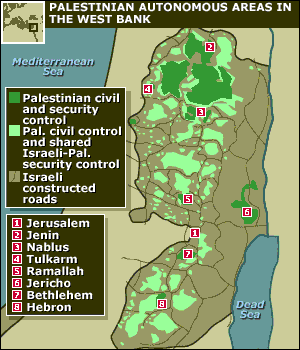
Well, it would signal seriousness about a two-state solution (how is this http://news.antiwar.com/wp-content/uploads/2009/05/westbank.... ever supposed to be a country? It's been almost completely Balkanized) and stop the theft of Palestinian land (it's very hard to feel ...less than ambivalent about a neighbouring country who allows its citizens steal your livelihood).
Basically, to stop this kind of conflict takes dialogue. Lots and lots of dialogue, with people who are serious about it. And not stopping the expansion of the West Bank settlements as per the Oslo Accords signaled that the Israeli government was not serious about its commitments.
(Hi, I'm Irish, I have a small idea whereof I speak, though not much.)
I never justified the settlements, I just think anti-Israeli sentiment wouldn't be improved any by removing the settlements. It almost doesn't matter if Israel does everything right or wrong anyway, because that's not the reason the world hates them.
(aside: There's a long distance between "please stop allowing or encouraging your government to treat other human beings in this terrible, terrible manner. Please think about the crimes done to them by your parents and grandparents - and by you. Please consider how you can encourage peace," and "we hate you." Or there should be, anyway; there are some very invested people.)
The bulk of the reason is antisemitism, with a good dose of groupthink on the side. In other words, it's become fashionable to hate Israel regardless of their actions.
When they make settlements it disturbs the peace process; when they unilaterally remove settlements, it also undermines the peace process. When they bomb or occupy a neighboring country it's an overreaction, but when that neighboring country is firing rockets into Israeli neighborhoods it isn't their responsibility. When a terrorist hate group takes control of Gaza and breaks away from the Palestinian Authority, they aren't disturbing the peace process, but when Israel and Egypt jointly declare a blockade on Gaza and Israel captures a "flotilla" trying to run the blockade, Israel are the oppressors--even though the supplies carried on the flotilla were merely inspected and passed through to Gaza anyway.
It's generous, and likely accurate, to say that those who hate Israel aren't thinking critically. Most people who take up intellectual fashions aren't thinking critically--that's why they take up intellectual fashions in the first place. But the more passionate ones are likely antisemitic. There are fair criticisms to be made, but there are also plenty of double standards at play as well.
When a terrorist hate group is the elected government of the Palestinian Authority, we expect you to deal with them as the elected government. Not to like it, but to do it.
Martin McGuinness, former member of the IRA army council, is Deputy Minister of Northern Ireland - a country he ran bombing campaigns to destroy (I'm not exaggerating: the explicit aim of the 30-year PIRA campaign was a reunited Ireland). Nelson Mandela is a convicted terrorist. We expect so much from you, yes. No-one expects this much from people they hate.
That tar-brush you're waving around is very, very wide.
How do you propose Israel deal with a group whose charter calls for the destruction of Israel?
Perhaps McGuinness is reformed (you did say former member of the IRA army council). Does he continue to call for the destruction of Great Britain? If not, you can negotiate with that. Israel has long negotiated with Palestinian factions that endorse a two-state solution, such as Fatah. Mandela accomplished the destruction of apartheid, and it was only by De Klerk's agreement to the end of apartheid that he and Mandela could deal with each other. With Hamas, only the destruction of Israel will suffice. What exactly is there to deal with?
I said he was one of the commanders of a guerilla army committed to the destruction of a country he now is Deputy Prime Minister of. If he is no longer a member of the Army Council (he denies ever being so, with as much believability as Clinton's denial that he did not inhale pot) it is because the political role he was playing became more important, and military activity was jeopardizing that work. Sinn Fein still seek a united Ireland, but are trying to accomplish it through political means.
This is the power of dialogue. You talk, you talk, you keep talking. You deal with the less extreme popular factions (analogy: https://en.wikipedia.org/wiki/SDLP), but the key word in that sentence is popular: an agreement with an organization with no backing in the community is an agreement with no-one. You do NOT commit to something and then completely disregard it, because then your word becomes worthless, and no-one believes anything you say ever again.
I do not know the solution. No-one does. But attempting to push the Palestinians into the sea is not it.
He wanted to "destroy" Northern Ireland by unifying the counties inside of it with the Republic of Ireland, instead of keeping them unified with Great Britain. This is not even an unreasonable stance for a North Irish elected official, is it? It takes a lot of equivocation to equate that with what Hamas wants to do.
We can agree that Israel has made a lot of mistakes. That doesn't legitimate groups like Hamas and that doesn't provide any basis for dialogue with Hamas, either. Meanwhile, the anger and hatred towards Israel would be there with or without the mistakes. It was there before the mistakes and it will be there long afterwards.
You can't suggest that Israel is well on it's way towards complete theocracy and deeper and deeper levels of state-protected misogyny while it's also losing any semblance of functional democracy and effective long term strategies without it being suggested.
Oh, wait, you can only say that about countries like Saudi Arabia. Silly me. Because the difference between flogging women and spitting on little girls is, you know, just so insurmountably vast.
And I'm not even touching the surface of valid criticisms that people just keep quiet about rather than utter, at least in America.
The worst part of it is that these criticisms generally have nothing to do with some sort of broad notion of Judaism as a religion or as a whole, but more particularly to Israel and its domination by short-sighted zealots.
That's because fear of being labeled is a deterrent from writing anything critical. To argue that this isn't a problem, find examples of people being critical and not being labeled.
Criticizing the actions of any government is what it is, but many critics of Israel go so far as to say there should be no Jewish state, which in effect means the Jews should be a people without a homeland, forever vulnerable to extermination by the Gentiles they are forced to live amongst as an eternal minority. That alone is suspicious as it carries the shadow of antisemitism, but once you throw in explicit support for groups like Hamas, the picture becomes clearer.
Except for a brief moment of shame after World War II, the general attitude of the West has always been antisemitic. Those seeking to criticize the actions of the Israeli government should have to work harder to distinguish themselves from the antisemites who merely disguise their attitudes as criticism of Israel.
> Those seeking to criticize the actions of the Israeli government should have to work harder to distinguish themselves from the antisemites who merely disguise their attitudes as criticism of Israel.
This is the opposite of "no true Scotsman" - "always true antisemite"?
Not at all. It's a recognition that if racists run around using code words to thinly veil their hatred, it behooves the rest of us to make sure we don't get confused with the racists.
I disagree, the Israeli government should be working harder to distinguish itself as a well-governed state, especially when looked at from the U.S. as there is a large sum of foreign aid and military aid going from our tax dollars to the state.
Criticizing the entire idea of a theocracy, and that a religion should (of course) have a homeland to dominate, does not make you an antisemite, nor covered with antisemitism "shadow." More an antisemitism smear.
Now, I am suspicious of the people who are irate about Israel as a Jewish state, but are all about the Dalai Lama. I don't see how that makes sense unless you have something against Jewish people.
The child of a Jewish mother is Jewish regardless of their religion, and this applies recursively, so you can have generation after generation of secular Jews as long as there's an unbroken matrilineal line. So Israel is not a homeland for a religion, it is a homeland for a nationality.
Sure, a convert to Judaism is also a Jew. But Judaism is explicitly not a religion for everyone, it is only a religion for the Jews. So if you believe in Judaism but have no desire to be a Jew yourself, you can just follow the Noahide laws. Actually becoming a Jew entails an extra step beyond that, namely the intention to join the Jewish nation. So not even in the case of conversion can the Jewish nation be equivalent to Judaism.
In practice, Israel is also just as secular as any Western country. No theocracy to be found there. This is more than you can say for, say, England, which has a state-established church with the monarch at its head.
>The child of a Jewish mother is Jewish regardless of their religion, and this applies recursively, so you can have generation after generation of secular Jews as long as there's an unbroken matrilineal line.
So it's just racist? I prefer to think of it as a theocracy that preserves a culture that has been historically very endangered. That, I don't feel as bad about.
>it is a homeland for a nationality.
If you, by law, make being a member of a religion a sufficient qualification for citizenship in a nation, this is self-fulfilling.
A theocracy is a government that governs based upon the dictates of religious doctrine. The Israeli government does not do this in any way, shape, or form. It is as secular as most Western countries.
Most nationalities are passed down by descent. If this constitutes racism, then so does the citizenship law of every nation that grants the right of citizenship to the children of a citizen. Nearly every country does this, so there is no reason to single out Israel unless you are trying to enforce a double standard.
Some nationalities allow outside individuals to join, and the Jewish nation is one of these. Like any nation, the Jewish nation has steep requirements of cultural belief and assimilation in order to join, namely conversion to the Jewish religion. But this is not merely a matter of belief. A Gentile who merely believes in Judaism is still not a Jew until they formally convert (i.e. joins the nation), just as an otherwise qualified foreigner who can pass the US citizenship exam is still not an American until they take the test and swear the oath to become a naturalized citizen.
There are many nationalities and ethnic groups that no longer have their own sovereign nation. Are they all "vulnerable to extermination by the Gentiles"?
That depends. Do we have a long history of trying to exterminate those other nations? We have a very long history of trying to exterminate the Jews, or oppressing them regardless.
The Romani have been historically oppressed, and were the victims of genocide along with Jews in the Holocaust. Where should their sovereign state be located?
I hope I'm not being a jerk, but there were lots of Jews in the first half of the 20th century that were opposed to Zionism. I assume you wouldn't accuse them all of being antisemitic.
Obviously not. But it's not up to Gentiles to decide the best strategy for the Jews to defend themselves from us, either. Likewise, what the Romani do to protect their nation is up to them.
I'm a completely uninformed white male, but I'm weary of drawing analogies between sexism and racism. It seems like reductionism, I think they should be tackled separately.
Well, we're at a stage in our society where you can't truthfully criticize some people because they happen to be members of select groups. Do so and you are accused of some kind of "ism".
As the GP poster indicated, this undermines those truly trying to fight a given "ism".
> ... one might argue that a woman may or may not understand a female target audience better
One might argue that women _on average_ may or may not understand a female audience better, but I can't even begin to think how someone wouldn't understand that variations between individual understandings would dwarf any potential divide here.
I'm not certain of the exact context since the comment has been deleted, but the impression I gained was that my parent comment suggested tenuously that a person could justify a sexist position taken against an individual due to a statistical bias in the sexes. I was trying to emphasise that this position couldn't be taken logically, not suggesting that "may or may not" was being applied in a non-aggregate fashion.