I am a graduate student, first-year, so I have a lot of problem sets to work on. I've been thinking about tau every so often since the last time this was posted here, and so every time I work a problem, I think to myself: would this be clearer if I used tau? And the answer is usually "no". Sometimes 2 is next to pi because of the natural reason appealed to in the tauifesto, and other times it's there for some other reason, other times it isn't there at all; there's usually a huge constant factor out front anyway, and often a single equation goes across the whole sheet of paper, so even making it one character shorter doesn't accomplish much.
Not that I haven't learned notation that really helps. Gaussian units and Einstein notation are a godsend. If you could standardize introductory physics courses using these, I think it could help significantly, especially when people struggle to work out the curl of a cross product or some-such strenuous vector calculation. All hail the Levi-Civita tensor! But we haven't even been able to agree on this.
Furthermore, as a test grader of nearly-a-year, the work done by undergraduates is nigh-inscrutable in the maximally acceptable way already, and so the tau "rebellion" promoted here would just make my job harder. It's not too much of an issue: only the technically-inclined, who already do pretty clear work, are likely to use it; still, telling people "just start doing your work like this, let them figure it out!" means that I have to know if that scribble is a tau or a T or what-have-you, two hundred times. Pi is a very recognizable character.
Plus, tau is the letter I reach for whenever I need to introduce an adjusted time of some sort, such as proper time; it's also the natural temperature in stat mech (though thermodynamic beta is itself more natural and usually better), it's torque, it's a common time constant, &c. People generally avoid pi as a character which does not represent 3.14159, though it is the prime counting function and an adjusted momentum, in which case it usually has a half-arrow, so you can tell what it's doing. We don't avoid tau at all; it's everywhere.
So the tau-switch, as notational improvements go -- and math has had many over the years -- seems like a relatively large-pain, small-gain deal. Many things must change, since pi is all over the place, but few are greatly improved. So I don't see much reason to use tau in my work, or for my students to use it in theirs. If it works for you, though, good!
To me it has almost nothing to do with "making it one character shorter," it's about making it easier to see fundamental relationships intuitively. It's not a notational improvement as much as a model improvement.
It's sort of like how angles can be measured using degrees or radians, but the derivative of sine is cosine only when using radians. It's not the notation of radians that is better, it's the model.
The biggest advantage of Tau over Pi probably lies in learning trigonometry for the first time. That's not something you can judge for yourself, as you can't learn something for the first time twice.
We should perform experiments, but I strongly suspect that using Tau (or 2Pi as if it where a single symbol) would significantly reduce confusion in the heads of the pupils. That would count as a "big advantage" in my book.
Now does Tau have an actual disadvantage besides clashing with time constants and such? If not, we should keep in mind that switching is a one-time cost while the cost of using a worse notation is unbounded (proportional to the number of uses, actually).
I have to reckon however that making an effort to switch away from Pi probably shouldn't be our first priority. I don't know Gaussian units nor Einstein notation, but if they do "really help" then we probably should take care of that first.
The biggest advantage of Tau over Pi probably lies in learning trigonometry for the first time. That's not something you can judge for yourself, as you can't learn something for the first time twice.
If you can live long enough, you could literally forget your trigonometry. After all, humans are not exactly the pantheon of long term memory or even...reliable memory.
Einstein notation is nice when you actually have to compute something, but it doesn't help in understanding the geometry of the problem.
In fact, it might be more of a hindrance because it encourages thoughts along the general line of I don't need to care about the geometry of the problem as long as I know how to calculate the stuff I'm interested in, or as a more specific example It doesn't matter if there's an upper or lower index as I can always contract with the metric tensor.
A personal pet peeve is when tensors are introduced as entities with given transformation laws (transforms like a vector in each component, etc) without ever mentioning specific geometric meanings.
Thing is, classical tensor calculus makes everything look the same - even things that aren't. I prefer the 'modern' coordinate-free notation of differential geometry (which has been around since at least the 60s), and it's easy to introduce Einstein notation on top of it...
For me, Einstein notation had the major advantage in electrostatics of reeling in the complexity of really long integrals that show up in boundary-value problems in electrostatics as well as being able to rederive formulas like "curl of curl is div-grad minus laplacian" by hand in seconds (which I always forget -- I took Calc ).
I had only a relatively cursory introduction to general relativity last semester; I have at best a vague understanding of Christoffel symbols, to give you an idea. So if Einstein notation can at some level become a way to fling symbols around and forget you're doing physics, I guess I haven't gotten there yet. I would like to think, though, that were it introduced alongside vector calculus instead of several years later, people might connect the adscripts with their meaning more easily.
Usually, if I want to understand the geometry of a problem, though, I find the best tool is a diagram, if at all possible.
For historical reasons, many areas of physics come with heir own notation, eg introductory courses on mechanics and electrodynamics are often done using vector notation you know from school with some additional differential operators thrown in, thermodynamics uses differentials, analytical mechanics and general relativity use index notation and quantum mechanics uses bras and kets.
Specialization sometimes makes sense, but it's non-obvious (at least it wasn't to me) that when checking if a force field is conserved by computing it's rotation, you're doing the same thing as when computing the derivative of a differential to see if it belongs to a conserved thermodynamical potential, or that the difference between a bra and a ket is the same as between a covector (lower index in Einstein notation) and a vector (upper index) - things look so different that it's hard to see when they are the same.
Another example is the relation between Newtonian and Lagrangian mechanics. In the lectures I took, it was presented as if Lagrangian mechanics is somehow special because you have an invariant formulation using generalized coordinates, wheres Newtonian mechanics was only ever done in Euclidean or Minkowski space.
It turns out that Newtonian mechanics is as invariant and general as Lagrangian mechanics (however, it's possible to further generalize Lagrangian mechanics, whereas as far as I can tell, you're pretty stuck with second-order system when doing Newtonian mechanics):
The Euler-Lagrange-equations are Newtonian equations and the differential of the Lagrange function dL is just a funny way to write down a force field - ie the main difference between Newtonian and Lagrangian formulation is that you require your force to be derived from a generalized potential (more formally: every hyper-regular Lagrangian system is a Newtonian system, any Newtonian system where the force maps to a closed form under the isomorphism T* TM ~ TT* M is locally Lagrangian).
In my opinion, lectures on theoretical physics are somewhat broken, and that's a more serious problem than the non-issue of whether to use τ or 2π…
PS: Please don't get me started on Christoffel symbols if you're not prepared for another rant ;)
The Leibniz sequence is the most simple way to describe the equivalence class under multiplication by non-zero rationals of numbers that contains both pi and tau:
1 - 1/3 + 1/5 - 1/7 + 1/9 - 1/11 + 1/13 - ...
which sums to equivalently pi/4 or tau/8.
The fundamental simplicity of the Leibniz sequence makes this value the only natural choice from that equivalence class. Let us call it lambda, for Leibniz.
Then the area of the unit circle is 4 lambda, the diameter of the unit circle is 8 lambda, the volume of the unit sphere is 16 lambda, the surface of the unit sphere is 16/3 lambda, etc.
I wouldn't call it nonsense. If the comparisons with the virial theorem and energy isn't enough to consider it at least as a reasonable choice, at least you should consider it as such because John Baez agrees with it.
I'm attempting irony. The tone of the manifesto is a bit breathless, putting up interesting enough considerations in a overwrought manner, with half-hearted efforts made at looking at the issues raised from more than one point of view.
Draft one of my lambda manifesto shows that the only consideration of conceivable value, namely ease of defining a transcendental by means of a convergent series, leads to only one possible choice of fundamental trigonometric constant, lambda.
I find the argument for tau very convincing. I remember having similar thoughts when I learned about radians and had a hard time understanding why they would define pi to be half of a turn, particularly since the diameter equation was d=2πr. The fact that A=πr² seemed like a counterargument, but the Tau manifesto makes a good case that having 1/2 in this equation helps show its similarity to other physics equations.
I think pi's best argument is that the area of the unit circle is pi. I actually find it very enlightening to think of the unit circle as having an area of pi but a turn of tau radians.
It makes sense to me to use both pi and tau; whichever makes a particular set of equations more clear. I certainly don't think that pi should be preferred just because it's older, or that pi's prevalence should prevent introduction of a new symbol.
Occam's razor to the rescue. Using two distinct constants which differ only by a factor of two sounds more confusing than choosing either one and sticking to it.
Occam's razor pertains to competing hypotheses that attempt to explain some phenomenon, not the question of which of several equivalent formulations is best.
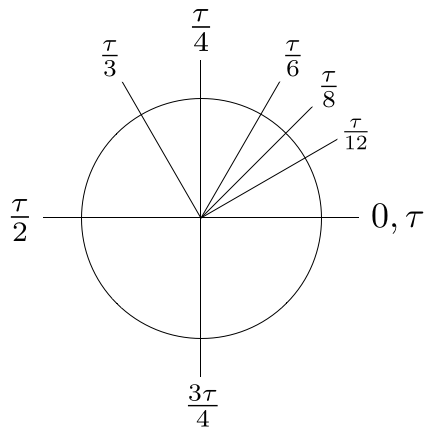
If you argue that there can only be one, I say tau is better. But to me it's less confusing to have both tau and pi, simply because both of these graphics seem very fundamental to me:
Well, today I think of Occam's Razor in the spirit in which it was originally offered, according to one translation, "One should not needlessly multiply entities."
Not only is it a great answer to the original question ("How many angels can dance on the head of a pin") but it is a great engineering principle as well.
So I agree with the GP who says that use of two competing variables which differ only by a factor of two is redundant and runs up against this principle.
> Using two distinct constants which differ only by a factor of two sounds more confusing than choosing either one and sticking to it.
Physics is incredibly unusual in that it has very few overloaded terms, and so almost everything that is expressed in daily use is expressed with as much precision and as little ambiguity as possible. Most scientific disciplines are not so lucky.
It does still happens in physics (h and h-bar, as noted in another response below), but it happens all the time in statistics, so much so that it's incredibly frustrating to read a new text for the first time.
𝜀? Probably refers to the error of a regression, assumed to have mean zero and be independent.
e? Uh-oh. Possibly refers to the error term in a regression, as above. But it could also refer to the residuals, which always have mean zero and are never independent. Very different.
ê? Okay, once I see this, I know that the author probably doesn't use 𝜀 as well, so this narrows it down somewhat. But not entirely.
And don't get me started about 'standard error'. I have heard that term used in reference to a sample mean, a sample mean divided by the square root of the population, or the standard error of a regression (which is more complicated than I care to describe in plain English).
Do you want to get started about economists, who often use π as a variable? Or computer scientists, who use it to refer to a process calculus?
How about Σ, which can be used to indicate a sum, but can also be used to indicate a covariance matrix? Which, by the way, can also be expressed in terms of either S or Q, depending on who you ask.
Ooh! How about Λ? That's the precision matrix, so it has to be precise, right? Well, yes, except that all we're doing is writing the inverse of Σ, so it's an unnecesary letter altogether[1].
Right now, we're dealing only with conflicts within a given field, but we could open Pandora's box and talk about the fact that λ is an anonymous function in computer science, but a constant that (partially) defines the stationary point for a given optimization problem.
Or letters that look like each other - can you really tell the difference between ν and v? Or ω and w? What about when I write them out by hand?
[1] Unless you're using the term to implicitly declare that the covariance matrix is invertible, but if you think that substituting one capital Greek letter for another is a clear way of telling me that a matrix is full-rank, we need to have a much longer conversation.
EDIT I must say, I'm very impressed that HN handled all that unicode beautifully. Kudos to pg (& co.?)!
"Right now, we're dealing only with conflicts within a given field, but we could open Pandora's box and talk about the fact that λ is an anonymous function in computer science, but a constant that (partially) defines the stationary point for a given optimization problem."
And it also represent a null character in linguistics, empty set in some set mathematics, null-pointer in some computer science texts, etc.
However tau will never beat out pi because of one very important reason. The chicken scratch that passes for writing these days makes tau unreadable. Tau can be a: r, 7, t, tau, etc...
For the sanity of TAs everywhere, please stop this madness.
Really? I just took off over half the points for probles that I couldn't easily read until handwriting improved. Students with illegible chicken scratch suddenly developed perfectly readable handwriting overnight. End of problem.
For my part, I write two very clear faces, an italic for my prose, and a block for my math. Writing clearly isn't difficult. The vast majority of people are already capable of it. Most of them at some point internalized that they had bad handwriting, perhaps rationalized because they were writing fast, and so write poorly because it's an element of their identity.
As for tau, I could see using a symbol for 2pi removing a class of error when I'm calculating, so I might adopt it. However, I doubt I'd use pi. More likely ð.
It's just a pi with one leg in the middle. It's pretty easy to read. Also engineers (who don't have very good writing) have been using tau for things like a time constant (among other uses) for a long time.
The bad handwriting problem is solved very easily, TAs should complain to the professor to make it a requirement that if you guys can't read it, it's wrong. I've had classes like this, I just use LaTeX.
Several fellow students and a couple profs started calling zeta "squiggly diggly". http://en.wikipedia.org/wiki/File:Zeta_uc_lc.svg I'm just glad the Hebrew and Phoenician alphabets haven't caught on more than they have already.
For a quick overview of the pedagogical significance of tau, compare figures 6, 7, and 8. I learned figure 6 in high school trig, but by "learn" I mean I basically memorized it without a deep understanding of what was going on. Figures 7 & 8 unveil what I had been missing.
I wish each letter could have only one use, but sadly that isn't possible (like some notorious equation from my plasma physics days that forced us to use different versions of P and Rho for density, pressure, charge density, and momentum).
I'm more of a fan of having multi-character symbols than to try and pigeonhole every concept into one symbol. Have full or partial names, just like we do in programming. We started down that path with writing things like sin x, cos t, div f, |rad|, etc. We should continue! If people really have problems distinguishing we can go the Perl route and add sigils.
Now that I have been programming for longer than doing maths, I just must wonder why math community seem so entrenched in using single letter variable/function names. How confusing larger source codes would be if programmers did the same.
You've never looked at academic or numerical code, have you? It's totally fugly. Go skim the first edition of Numerical Recipes in C--it'll give you nightmares.
I'd say it's the other way 'round: the problem of the invisible multiplication operator is that it precludes multi-character symbols. (I think Dijkstra wrote about that.)
Yup, and he was absolutely right. I've adopted multicharacter names (though usually abbreviations or short ones) for my day to day calculations, and a visible multiplication.
Mind you, if I get deep into integration and the only reflexes from my Jackson days kick back in, the notation reverts entirely. At some point it magically switches back after the act of integration is done, though.
Well, I almost typed PHP, since that was my first programming language, but that seems to have a bad reputation around here. The downside to subscripts is I have to write smaller, but I guess they might be better depending on your opinion of sigils. I still remember though wondering why JavaScript, when I was learning it, didn't have dollar signs in front of all its variables like PHP did, since it seemed like a great idea to my younger self. Eventually as I learned more languages and practiced more programming I realized sigils are unnecessary, like Hungarian notation (which I'm glad I never used and I'm glad its practice was basically already dead by the time I picked up programming). People won't get confused. Just like people don't get confused when they see sin3/5pix on paper and misinterpret sin(3/5 * pi * x(t)) as s * i * n * 3/5 * pi * x.
Fellow Mechi here. Yes, they can do that tau revolution without us.
In the dynamic equations, tau is also used for the "generalized forces" (a vector/array which contains all the forces and torques that act on the generalized coordinates). At the same time, they are usually full of trigonometric functions (with 2*pi).
I can only recall one time in my academic career where someone used pi for something else than a time constant or circle constant. It made me feel so uneasy ...
It isn't innovation from a math sense, it's innovation in a pedagogical sense. Once you've internalized pi (and math in general) it is pretty hard to see what is so difficult about it (a well studied issue with expert knowledge and teaching things to novices). However a simplification from the point of view of the novice who doesn't "just get it" is a good thing.
However a simplification from the point of view of the novice who doesn't "just get it" is a good thing.
Questions about mathematics pedagogy are inherently empirical, and should be answered by observation of actual learners. So where is the evidence that learners who don't get how to use π will be better able to learn mathematics if they use τ to tackle the same problems?
I don't know. Perhaps they are still at the "convince someone to actually try it for an entire n-year math curriculum" stage? It's not like using Tau is something that you can do in class for a week and expect better results. Even if you try the lesser "here's tau, always substitute 2pi with tau" every couple years on a group of students and track them through their math learning, it takes time and a lot of effort to get those numbers.
In the mean time, there is lots of anecdotal evidence of people understanding a lot of concepts easier with it, suggesting these studies be done in a scientific way.
Using τ is better than using π for the same reason (albeit not as strong a reason) that using π is better than using g=17π. It has little to do with convenience, and more to do with conceptual clarity. Actually, the difference between g and π might be less bad, because at least when mysterious factors of 17 appear you would know where they came from. On the other hand, the factor of 2 that rides along when you choose to use π over τ could come be confused with a million other factors of 2.
Nope. Although they are both conventions, in the electric charge there is really no natural choice. While mathematicians can argue whether or not a factor of 2 is a natural choice for a convention.
Isn't the “natural” choice to have the direction moving charged particles to be the same as a moving charge? In everyday life it is electrons, not protons that move. When we say "charge is moving from high voltage to low voltage" we are actually saying "electron particles are moving from a position of low voltage to high voltage"--the exact opposite. How is that natural?
Even if that weren't the case, it's still a matter of opinion. Minus signs show up in a number of pretty unnatural positions as a result of the negative electric charge. The convention in Physics is that minus signs convey semantic information (reversal in direction, slowing down, etc.). The negative electric charge upsets this convention, resulting in un-semantic minus signs.
I use a different definition of natural. The fact that the electrons, negatively charged, were moving wasn't known when they assigned the positive-negative labels. But still, although what you are saying is certainly true in proton/electron systems, it would be completely reversed in antiproton/positron systems, where the charge would be moving together with the particles.
Also, don't forget of ions, or particles in space, or in particle physics experiments, where both charges move.
The point is that the natural choice that you assign would be natural just because of some contingent conventions, but it's not more natural in terms of some more fundamental/mathematical meaning. While the pi vs. tau is.
The benefit of the easier formulas tau might provide. Minus. The confusion of having different generation of students being taught differently.
Is it worth it?
The author tries to dismiss this by saying "it's easy, they'll get it quickly, we don't need to rewrite all textbooks if you can just say 'let tau = 2pi'". But it seems he's rushing in that conclusion. The imagine the confusion between trying to convince students who are used to a whole set of formulas to use new ones will be huge. The confusion caused by different generations trying to communicate seems huge. You might not need to burn old books but you would need to write new ones, which again does sound like a huge endeavor.
I'm not even questioning whether he's right about tau formulas being easier. That seems irrelevant to me. Just the problems you're creating with the confusion seems not worth the small benefits. It just doesn't seem the pros outweigh the cons.
As in - because pi is a unit-less ratio? Plank units are still units (albeit a special case), so I don't agree with your syllogism.
However, what I meant was the human processing overhead in converting between units. I mean, pi is correct, for what it is. Tau would simply be easier for humans to use, much like SI units.
Tau is better than pi because a lot of useful expressions have 2pi as a term; SI is better than imperial because we happen to have ten fingers. Tau is a universal simplification like Planck units; SI is merely an anthropocentric simplification.
I think the greatest advantage of the SI system is that it's exponential. I don't care that much about what base is used, but switching is just confusing (12" = 1', 3' = 1yd).
Pi is better then tau because all of our damned engineering formulas have pi. SI is, however, the right answer (though useless without reference tools, whereas imperial isn't).
math background and then studying robotics for a bit, where all we have are models of the reality, I now laugh at such comparisons.
Both Tau and Pi are models for mathematics that work- to argue which is true is nonsense. They are both correct but neither is true, or god-chosen. We made them up, folks!
π is not "wrong", that doesn't make any sense. However, I agree with the author that expressing things by using π is more complicated and not as elegant as expressing things with τ.
> It should be obvious that π is not “wrong” in the sense of being factually incorrect; the number π is perfectly well-defined, and it has all the properties normally ascribed to it by mathematicians. When we say that “π is wrong”, we mean that π is a confusing and unnatural choice for the circle constant.
I don't give a damn about tau. On the other hand, the way π is rendered on Firefox on Windows is so wrong... it looks just like a small version of Π (capital pi), or the Cyrillic small Pe:
Sure, creating new stuff doesn't necessarily imply throwing everything out each time you make an addition or change.
It would be like a startup guy re-inventing alarm clocks and breakfast every morning, followed by re-inventing showering, shaving, dressing, opening the door, entering the car, starting the car, what lane you drive in, etc.
You'd never get to your workplace to do whatever it is that your startup is creating ("We Are Re-inventing Innovation!" -- you might think I'm joking but that's a common tagline even PARC used it).
Some stuff you take as it is (a baseline) and you create around it.
Maybe tau is something to consider more seriously but pi has done pretty well for itself and many don't consider changing it to be a big priority.
instead, so that it's clear that it's a math constant instead of a local variable? Also, I suspect that the math.h pi constant is accurate to more than 8 decimal places, so this way you don't lose precision.
What I really mean is this: use it. If you're a tauist, but tau isn't in your header file / constant library / whatever you use, today might be a good day to put it there.
Good article, and your arguments are strong. As long as we're being contentious, though, I would like to point out that e is a more interesting number than τ or π. Sure, you can make circles with π (or τ) and do angular calculations galore, but without e you've really got nothing more than that. Rate of growth? Compound interest? Hidden things of the universe? Fuhgedaboutit.
The Tau Manifesto author here. Don't yell it too loudly, but I strongly agree: e is by far the most important of these numbers. But e is the natural choice, so I don't have any bone to pick with it. (Bob Palais made an analogy in "Pi Is Wrong!" Suppose e were defined as 1/2.718281828... Then there would be confusing negative signs everywhere. Exponential decay would have a positive exponent, etc. Such is the case with τ and π, with a factor of 2 in place of a factor of -1.)
This argument gets pretty complex, but the thing I like about pi is that it is fundamental. Sure 2 * pi might occur more commonly in important expressions, but 2 * pi is only special because pi is special.




Not that I haven't learned notation that really helps. Gaussian units and Einstein notation are a godsend. If you could standardize introductory physics courses using these, I think it could help significantly, especially when people struggle to work out the curl of a cross product or some-such strenuous vector calculation. All hail the Levi-Civita tensor! But we haven't even been able to agree on this.
Furthermore, as a test grader of nearly-a-year, the work done by undergraduates is nigh-inscrutable in the maximally acceptable way already, and so the tau "rebellion" promoted here would just make my job harder. It's not too much of an issue: only the technically-inclined, who already do pretty clear work, are likely to use it; still, telling people "just start doing your work like this, let them figure it out!" means that I have to know if that scribble is a tau or a T or what-have-you, two hundred times. Pi is a very recognizable character.
Plus, tau is the letter I reach for whenever I need to introduce an adjusted time of some sort, such as proper time; it's also the natural temperature in stat mech (though thermodynamic beta is itself more natural and usually better), it's torque, it's a common time constant, &c. People generally avoid pi as a character which does not represent 3.14159, though it is the prime counting function and an adjusted momentum, in which case it usually has a half-arrow, so you can tell what it's doing. We don't avoid tau at all; it's everywhere.
So the tau-switch, as notational improvements go -- and math has had many over the years -- seems like a relatively large-pain, small-gain deal. Many things must change, since pi is all over the place, but few are greatly improved. So I don't see much reason to use tau in my work, or for my students to use it in theirs. If it works for you, though, good!