tl;dr - the policymakers who made the decisions were not economists, they were politicians who ignored economists' advice. Namely, they refused to embrace fiscal measures (deficit spending, including through the self-triggering methods of the welfare state) and relied entirely on "confidence-building" measures and on the monetary tools available to central banks - which were, as economists' models predicted, ineffective in the prevailing circumstances.
If economists, collectively, had demonstrated a bit more prescience before 2008, they might have had a bit more credibility afterwards. Nor does it help that it seems you can find a distinguished economist on either side of any issue that matters.
Outside of some people involved in the very-much off the books and unregulated bond markets, I doubt many economists had much to go off of. Before default rates rose catastrophically in a short period of time (I think, two and a half years or so?) there was no visibility into what would quickly become a failing market.
The complex instruments being bought and sold, likewise, there were economists who looked at those things and said, "Wait a second, you can't bundle a bunch of correlated instruments and expect to create an uncorrelated one." Some of these economists decided to make a great deal of money betting against the banks. Others decided not to because of the adage that the market can stay irrational longer than one can stay solvent. Still, I don't think many academic economists had visibility into what was going on in the mortgage bond market, and it's not like banks were advertising statistics on their predatory - and sometimes illegal - lending.
I think on a variety of important issues, it's possible to read the economists and find a broad consensus. Perhaps some outliers, but where there's data, there's often consensus. I follow the IGM Forum[1] which surveys a broad swathe of economists on issues, and quite often on issues I thought might be partisan, the economists show a decided consensus opinion I was unaware of.
Your reply about why the economists failed to predict the 2008 crash is an example of the problem the article is about. The economists didn't need a lot of technical information. They just needed to know that for a couple of hundred years banks had been careful about who they gave mortgages to because if they defaulted they would take a loss, but then they started bundling and selling them, so they felt safe to make it far too easy to get a mortgage. And that the bond rating agencies had a severe conflict of interest because they were paid by the people selling the bonds. And that credit default swaps are unregulated insurance.
Except for the cds part, all that was common knowledge. A little common sense would tell you this was a recipe for disaster, and in fact this was pointed out by people like Dean Baker at the time. The question is why the great majority of economists didn't take 30 seconds to look at the facts and agree, and the answer seems to be they simply lack common sense.
>But his prime examples of economics malfeasance are, well, terrible:
>Policymakers don’t know what to do. They press the usual (and unusual) levers and nothing happens. Quantitative easing was supposed to bring inflation “back to target.” It didn’t. Fiscal contraction was supposed to restore confidence. It didn’t.
>“Supposed to” according to whom? Not basic macroeconomics!
>Look, we had a more or less standard model of macroeconomics when interest rates are near zero — IS-LM in some form. This model said and says that (a) monetary policy is ineffective under these conditions (b) fiscal multipliers are positive and large — in particular, fiscal contraction is strongly contractionary. And these predictions have been borne out! Huge monetary expansion didn’t raise inflation; extreme austerity was strongly correlated with severe economic downturns.
>In other words, policy had exactly the effects it was “supposed to.”
Krugman actually used his ISLM model to decide to remortgage his house in 2003, and in a bout of epic predictive failure, foresaw skyrocketing interest rates:
"With war looming, it's time to be prepared. So last week I switched to a fixed-rate mortgage. It means higher monthly payments, but I'm terrified about what will happen to interest rates once financial markets wake up to the implications of skyrocketing budget deficits."
According to the data, not really. Short-term mortgage rates increased steadily for the next several years; long-term rates also ticked up, but not by as much.
He basically refinanced his home exactly at the bottom [1].
If the 2008 crisis hadn't happened, do you really think interest rates would be where they are now? I think it's easy to imagine a very different tail on that curve post-2008, which would have left the 2003 low intact.
If you're asking Krugman to have predicted the 2008 crisis in 2003, I think that's a bit much.
Krugman's bet - in his own words and using ISLM - was that interest rates would skyrocket because of deficit spending on the Iraq war in 2003. He paid extra to make this bet.
From the article: "And as that temptation becomes obvious, interest rates will soar. It won't happen right away. With the economy stalling and the stock market plunging, short-term rates are probably headed down, not up, in the next few months, and mortgage rates may not have hit bottom yet. But unless we slide into Japanese-style deflation, there are much higher interest rates in our future." (emphasis mine)
Inflation doubled from 2002 onwards, then the housing bubble popped, causing inflation to fall. Thankfully not into a long-term deflationary spiral, though.
Yeah, that was the best part. "This is going to be awful. It's going to happen. Unless, that is, the exact opposite of what I'm betting on happening actually happens".


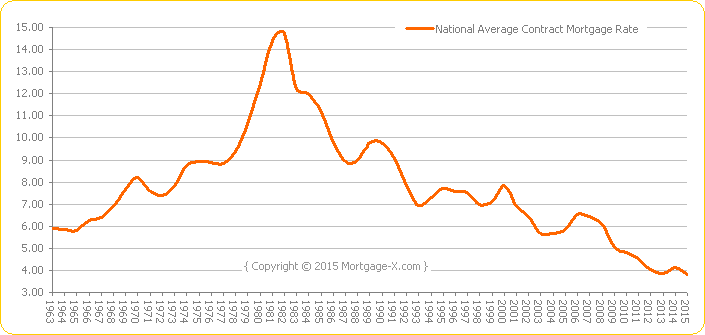

http://krugman.blogs.nytimes.com/2016/12/24/dont-blame-macro...