Maybe blame consumers rather than manufacturers. And if a government sets up incentives incorrectly, blame the government schemes, not those using such badly designed incentives.
The buyers wanted a petrol car. And they choose to fill with petrol. You need your own garage to make plugging in worthwhile (and avoid getting charging cable nicked). Consumers perhaps prefer to avoid the hassle of plugging in?
In New Zealand there's a visible disincentive of a yearly tax on pluggable hybrids (to pay for road use). In NZ roads are paid by taxes earmarked for that.
> In NZ roads are paid by taxes earmarked for that.
It would be better to say that all of the money from road use and petrol taxes are spent on the roads. Those taxes don't actually cover the cost of maintaining the road system.
At which point it kind of becomes moot that those taxes are ring-fenced for paying for roads. Since I've lived here people keep repeating that ring-fenced fact like its some kind of special thing. General taxation and council taxes are subsiding just the road maintenance, and completely paying for new build roads.
If we measure consumer surplus as a percentage, how would it compare to business profits as a percentage?
Edit:
Nobel laureate William Nordhaus studied the historical data of the U.S. economy and concluded that innovators and corporations capture only a tiny fraction of the total social value they create. Consumers capture ~98% of the value in the form of surplus. Producers capture ~2%.
Yes: Page 30 of The Operator's Guide for IBM 3270 Information
Display Systems calls it a Tab key.
   Tab also has typamatic capability that allows you to move the cursor quickly from field to field.

  The Back Tab key moves the cursor back to the first character position in an input field. If the cursor is already in the first character position of an input field, and if you press the Back Tab key, the cursor will then move back to the first character position of the preceding input field.
So my guess is that the cursor defaults to being at the start of a field as you navigate, so Tab and Back Tab work as expected. But if you're editing a field and have moved the cursor within the field then Back Tab acts differently.
This is correct. It's also worth pointing out that the 3270 defaults to overwrite rather than insert mode, and has an "Erase EOF" key that deletes all text from the cursor position to end-of-field.
The banks make very low profits on 0% interest (government subsidised green) loans with a max total lending limit of NZD50k and many approvals might be less than $10k. The loan needs to use the home as collateral.
It wouldn't be cost effective (for bank or lender) to originate a new loan: instead the green loan uses the paperwork from an existing loan.
The bank can use the existing mortgage's legal paperwork to attach the new debt to the lender's house for collateral.
Approval, legal, and eligibility costs are reduced because an active loan has already been approved. The bank mostly wants to check that the lender's likelihood of repayment hasn't drastically worsened (e.g. lost their job).
my guess is that the loans are not profitable for the banks - and the banks don't really want to manage these loans - many of which might be just a few thousand dollars.
Because it is a government program it is likely the banks don't want to be seen (by lenders or the government) as making a profit (even if they were just trying to cover costs).
Program restrictions likely prevent banks from using fees to make a "profit" since 0% interest doesn't leave much room for banks to make money.
I assume the government funds the loans and I assume the government doesn't underwrite the liability. I would guess the funding is limited and the government is very tight, restricting any potential profit for the bank.
You'd need to look at the government documentation.
- Steve Huffman ~3% Although he had ~4% voting power via Class B shares.
- Alexis Ohanian: Minimal
- Advance Publications: ~30%
- Tencent: ~11%.
The original founders (Steve Huffman and Alexis Ohanian) massively diluted when they sold Reddit to Advance Publications in 2006 for $10 to $20 million.
How good are LLMs at understanding Haskell errors and then dealing with them?
The last time I had a go with Haskell, the errors reminded me so much of hellish terminal compilers from the 80s and 90s that I quickly gave up. Been there, not doing that again.
> There's plenty of freshwater fish that are farmed around the world
Farmed fish are often fed on fish meal from the ocean - e.g. fish meal made from species that are not eaten by people. Between 5% and 10% of ocean fishing is used for such aquaculture.
Same same as the cattle example in Ireland being fed on imported animal feed.
That's only because that bycatch is almost free of charge in areas with significant ocean fishing fleets.
You can provide the right mix of proteins and fats from algal and insect sources, so this shouldn't be a barrier to increased adoption of fish farming.
(Scaling wastewater and disease management are perhaps greater challenges, but ought not to be intractable either)
Battery dimensions are same as CATL's 587 Ah lithium storage cell:
Length 73.5mm
Width 286mm
Height 216mm
Apparently dimensions for the lithium cell were designed based on constraints: maritime transport weight limits (50t), 1500V max system voltage ceiling, 20-foot container (turn key system - image https://www.ess-news.com/2025/04/16/hithium-unveils-587-ah-c... ).
I assume the Sodium cells are heavier but they chose the same cell size for physical backwards compatibility.
Perhaps the US can use this as a worldwide strength. Good standards are very powerful.
I'm from NZ and because we import everything, we follow frequency/power/encoding regulations from elsewhere.
Aside: NZ has different plugs but I sure would like to avoid those exploding wallwarts. The last one splattered molten metal and broke the screen of my phone.
Dealing with faulty devices due to communications failures is also expensive (or impossible to diagnose/fix) so standards can help avoid that.
> notice that all the connection on the USB port are not all the same length, it is a form of protection
This was noticeable on USB-A connectors when you look closely where the two outside pins were slightly longer than the two inside pins: the Make-First, Break-Last (MFBL) principle. You can also see the same thing on SATA edge connector pins.
Take care googling for photos because many are CAD mockups misinform (because they are drawn pretty incorrectly and show no physical length differences).
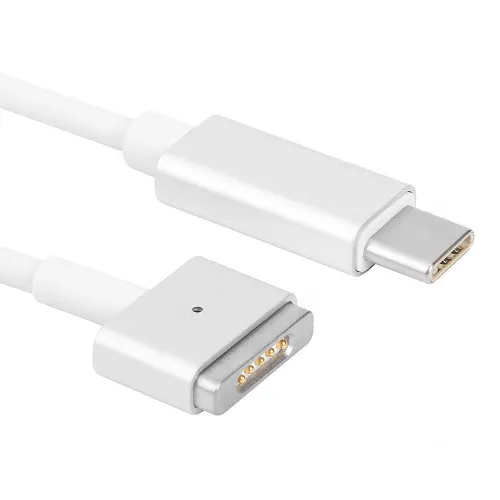
USB-C does have longer pins for the ground, and the CC (configuration channel) connects last. A USB-C host doesn't deliver power until it is negotiated using the CC pins.
So USB-C via a "magsafe" connector is safe.
But maybe look for the two outermost pins to be longer.
You mention ESD which could be riskier since charged fingers or worse could touch contacts directly. However the lip around the contacts is usually grounded so any spark should be grounded first. I would also assume modern electronics are well protected against ESD (nobody wants occasional undiagnosable failures leading to refunds). Sure that stuff from earlier this century wasn't so well protected. YMMV if you are a sparky person in a sparky environs: weigh the downside costs of different approaches appropriately.


The buyers wanted a petrol car. And they choose to fill with petrol. You need your own garage to make plugging in worthwhile (and avoid getting charging cable nicked). Consumers perhaps prefer to avoid the hassle of plugging in?
In New Zealand there's a visible disincentive of a yearly tax on pluggable hybrids (to pay for road use). In NZ roads are paid by taxes earmarked for that.
reply